
Cold and warm plasma work through different mechanisms. At Roses & More, having access to both does not mean every skin needs both. We assess the skin first, then decide whether plasma has a role at all — and which mechanism makes sense.
A Skin Science Note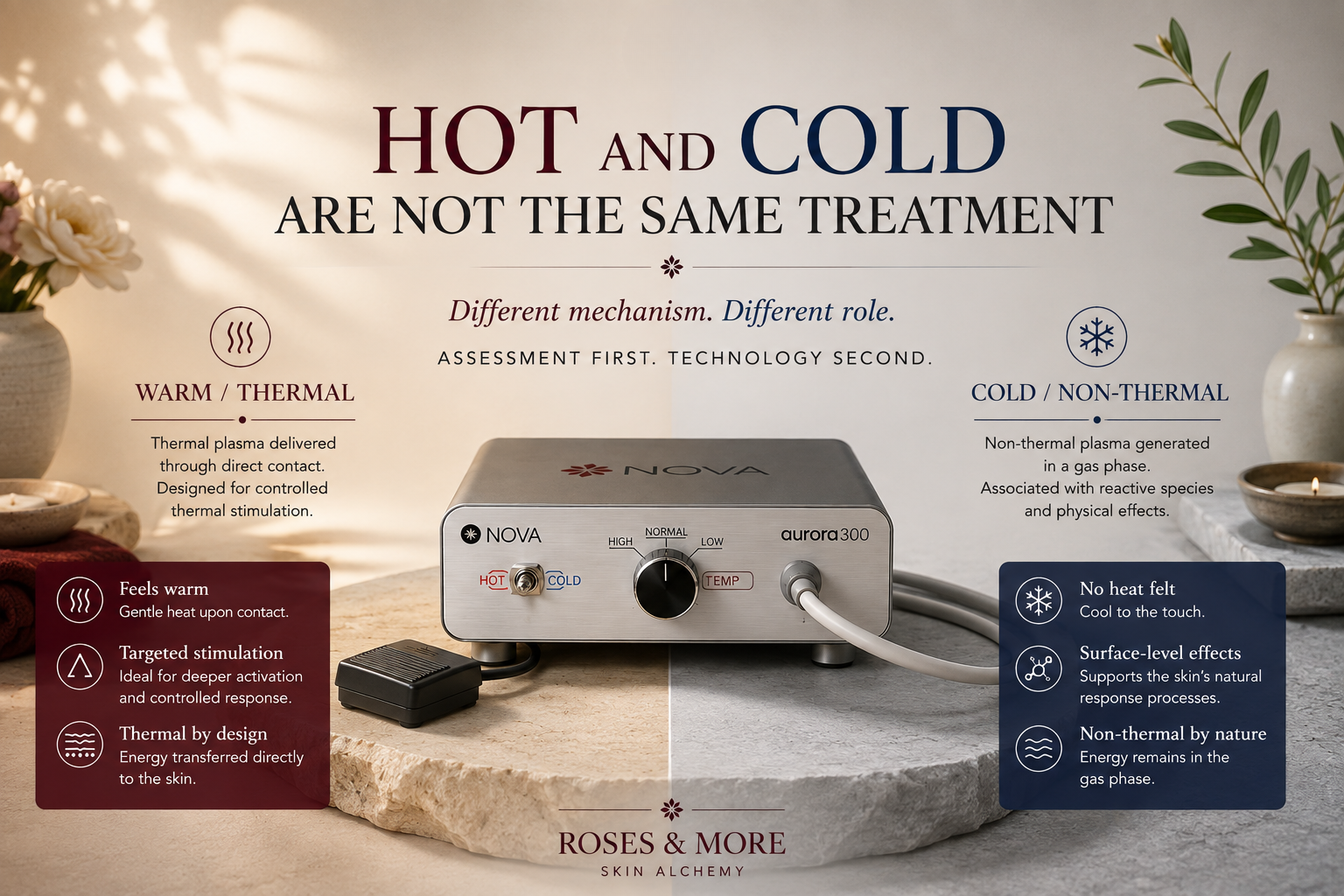
“Plasma” Does Not Describe One Treatment
Cold plasma and warm or thermal plasma share a name, but they do not create the same treatment conditions. One is non-thermal; the other deliberately introduces a thermal effect. That difference gives them different potential roles.
At Roses & More, having access to both mechanisms is useful precisely because we do not have to treat plasma as one fixed intervention. We can first decide whether plasma belongs in the treatment at all, and only then consider which form of plasma makes sense.
Dual capability does not mean dual treatment. It means having more than one mechanism available when the skin calls for it.
Cold Plasma: A Non-Thermal Mechanism
Cold atmospheric plasma is a non-thermal plasma modality. Its biological effects are associated with plasma-generated reactive species and other physical effects rather than deliberate tissue heating.
This makes it fundamentally different from thermal plasma. Research into cold atmospheric plasma spans dermatology, wound care, microbial control and skin biology, although those research settings, devices and applications are not interchangeable with cosmetic treatment.
For Roses & More, the important point is not to turn those mechanisms into a universal list of promised results. It is to understand when a non-thermal plasma mechanism may have a useful role within a particular treatment objective.
Warm Plasma: A Thermal Mechanism
Warm or thermal plasma works differently because controlled heat is intentionally part of the treatment mechanism.
Thermal stimulation can therefore be considered for objectives that differ from those for which a non-thermal approach might make sense. But “more thermal” does not mean “better”, and a stronger stimulus is not automatically the correct stimulus.
Settings, delivery, treatment area, skin condition and treatment objective all matter. The presence of a thermal mode is a capability — not an instruction to use it.
Non-ThermalCold Plasma
A plasma mechanism whose biological effects are not primarily produced through deliberate tissue heating. Considered when that mechanism fits the skin and treatment objective.
ThermalWarm Plasma
A plasma mechanism in which controlled thermal effect is deliberately part of treatment. Considered where that type of stimulus is appropriate.
Having Two Mechanisms Does Not Mean Using Both
This is where the idea of “dual plasma” can easily become misleading. A device that provides both cold and warm plasma does not create a requirement to combine them.
Sometimes cold plasma may have a role on its own. Sometimes a thermal plasma treatment may be appropriate. Sometimes both mechanisms may make sense within a carefully considered treatment composition. And sometimes neither belongs in the treatment.
Technology capability is not treatment indication. The fact that a device can provide two plasma mechanisms does not mean that every skin needs either — or both.
What We Assess Before Choosing Plasma
The decision comes before the device
- What the person actually wants to improve
- What the skin is presenting today
- Current resilience, sensitivity and treatment tolerance
- Previous procedures and responses
- Whether a thermal or non-thermal mechanism fits the objective
- Whether another modality — or no device at all — makes more sense
This is why two people arriving with the same concern may receive different recommendations. The concern provides context. The assessment determines the treatment logic.
Where NOVA Plasma Fits at Roses & More
NOVA Plasma gives Roses & More access to both cold and warm plasma modes. We value that flexibility because different mechanisms can serve different treatment objectives.
But the machine does not determine the protocol. Nor do we begin with the assumption that “dual plasma” means using both modes in a predetermined order.
Instead, we move from the skin to the objective, from the objective to the appropriate mechanism, and only then to the technology and treatment sequence.
We don’t begin by asking how to use both plasmas. We begin by asking what the skin needs.
Dual Plasma Within Treatment Sequencing
Treatment sequencing is useful because it allows different mechanisms to be considered as parts of a wider treatment composition rather than as fixed menu items.
If both cold and warm plasma genuinely have a role, the sequence should follow the treatment objective and the skin’s condition — not a blanket rule that cold must always come first or that warm must always follow.
The sequence can also change over time. What makes sense at one visit may not be appropriate at the next.
Sometimes the Right Choice Is Neither
Good technology selection also means being willing not to use the technology.
A quieter restorative treatment, controlled microneedling, ultrasound, manual work, botanical care or simple restraint may make more sense depending on what the skin is presenting and what the treatment is trying to accomplish.
Having more options only becomes valuable when we are equally comfortable leaving those options unused.
This article provides general educational information about plasma technology and Roses & More’s assessment-led approach. Plasma devices, settings, delivery methods and clinical research applications vary. General plasma research should not be interpreted as a guarantee of a specific cosmetic treatment outcome.
The Technology Follows the AssessmentDifferent Mechanisms. Different Roles.
If you are considering plasma, we begin with the skin and the treatment objective — then decide whether cold plasma, warm plasma, another modality or no device at all makes sense.
Explore Our Technology WhatsApp Us— Roses & More Skin Alchemy
64B Peck Seah Street, Tanjong Pagar, Singapore