
A homecare ritual Singapore women actually keep looks nothing like the twelve step routine sold to them online. It looks like three or four things, done properly, every single day.
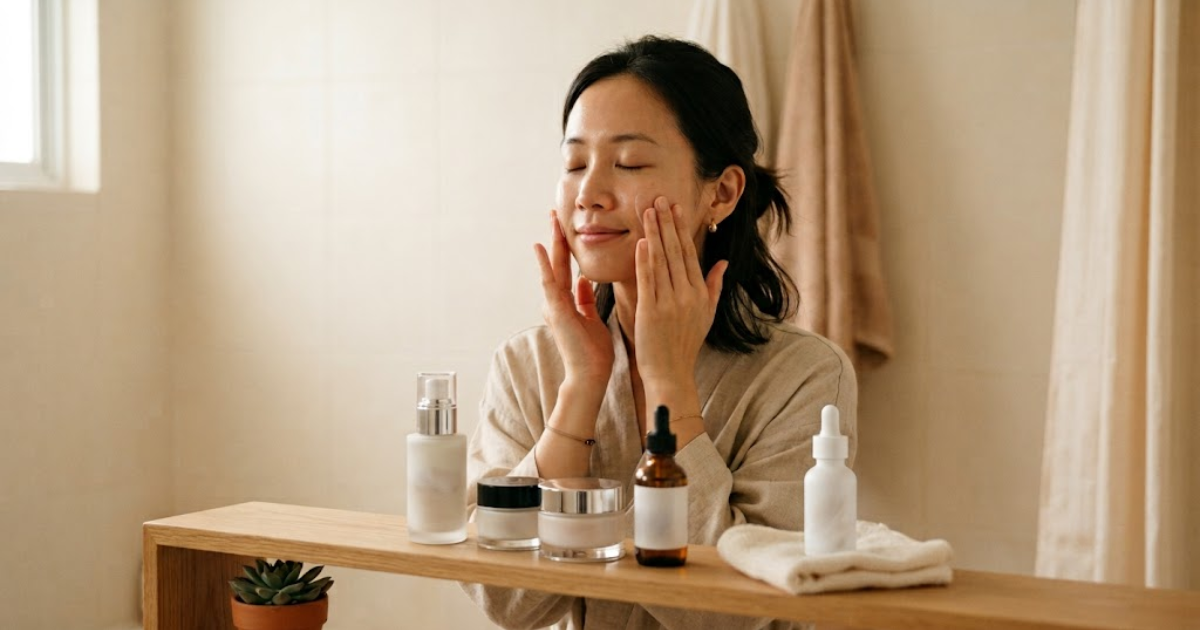
A homecare ritual Singapore clients can genuinely sustain does not need to be elaborate. It needs a clear purpose, an order that makes sense, and few enough variables that both you and your skin can understand what is working.
More Steps Do Not Automatically Mean Better Skin
Skincare has become increasingly easy to complicate.
There is always another serum, another active, another exfoliant, another mask, another ingredient that seems compelling enough to add.
None of those things is necessarily wrong.
The problem begins when the routine accumulates faster than our understanding of it.
Eventually, the shelf contains so many variables that it becomes difficult to know which products are useful, which are unnecessary, which may be contributing to irritation, and which have simply become habit.
Complexity is not evidence of sophistication. A good routine is one in which every step has a reason to be there.
Simple Is Not the Same as Minimal
We are not interested in minimalism for its own sake.
Three products are not automatically better than six.
A very simple routine can still be poorly chosen. A more detailed routine can be completely reasonable if the skin tolerates it, every step has a clear function and the person using it can realistically sustain it.
So the goal is not:
How few products can we use?
It is: what does this skin need, which products have a useful role, and what is the simplest routine that accomplishes that without unnecessary duplication?
What Makes a Homecare Ritual Sustainable
The best routine on paper is not necessarily the best routine for the person who has to live with it.
A ritual has to survive tired evenings, early mornings, travel, work, children, deadlines and all the other things that happen outside a treatment room.
- Few enough steps that you can perform them consistently
- A clear reason for every product being included
- An order that is easy to understand and repeat
- Products your skin actually tolerates
- Enough stability that you can recognise when something changes
- Room to evolve when the skin’s needs change
Consistency matters because skin care works through repeated use over time, not because a longer routine somehow earns more credit.
And consistency becomes easier when the routine makes sense.
You Know Your Skin Better Than You Think
You live with your skin every day.
You know when a cleanser suddenly starts to feel too drying. You know when a familiar product begins to sting. You notice when the skin feels more comfortable, less oily, more reactive or simply different.
That lived observation matters.
It does not mean you have to diagnose every change yourself.
It means the most useful homecare conversation is collaborative.
Your job is not to know every ingredient. It is to notice what your skin is telling you. Our job is to help make sense of the pattern.
Why Too Many Variables Make Skin Harder to Read
Suppose the skin suddenly becomes irritated after five products were added or changed in the same week.
Which one caused it?
Perhaps one product is responsible. Perhaps two work poorly together. Perhaps the frequency is too high. Perhaps the change has nothing to do with skincare at all.
With many simultaneous variables, it becomes much harder to know.
This is one reason we often prefer deliberate changes rather than wholesale routine overhauls.
The skin’s response becomes information.
That same logic sits behind our approach to skin barrier repair : sometimes understanding what to remove or reduce is as useful as deciding what to add.
Homecare Is Part of Treatment — But It Is Not the Whole Treatment
What happens between appointments matters.
Appropriate cleansing, moisturising, sun protection and targeted actives can support the objectives we are working toward in the studio.
But we would not say that homecare alone determines whether every treatment succeeds or fails.
Some concerns depend heavily on homecare. Others involve mechanisms that topical products cannot provide. Lifestyle, environment, medical factors and the skin’s own biology can also affect what happens over time.
Homecare is therefore one layer of the strategy.
An important one — but still one layer.
Brand Agnostic Means Your Shelf Does Not Have to Match Ours
Roses & More is deliberately brand agnostic.
That principle applies to homecare just as much as it applies in the treatment room.
We do not need every product in your bathroom to come from one range.
We do not need every product to come from us.
And if something you already own is working well, there is no prize for replacing it simply to create a more aesthetically consistent shelf.
The question is not whose logo is on the bottle. The question is what the product is there to do, whether the skin tolerates it, and whether it earns its place in the sequence.
Homecare Through the Skin Sequencing™ Lens
This is where homecare fits into our wider Skin Sequencing™ framework.
We begin with the skin.
What is it presenting?
What are we trying to achieve?
What is already working?
Which products have a reason to remain?
What, if anything, should change?
And in what order should any change happen so that we can understand the skin’s response?
Homecare is therefore not a static prescription written once and followed forever.
The routine can evolve as the skin evolves.
A Ritual Should Make Your Life Easier
Good skincare should not require an advanced degree in remembering what happens on Tuesday nights.
Nor should opening the bathroom cabinet produce guilt because half the products are unfinished.
A useful ritual becomes quiet.
You know what to use.
You know roughly why it is there.
You notice when something changes.
And you have enough confidence in the routine that you do not feel compelled to replace it every time a new ingredient becomes fashionable.
The best routine eventually becomes boring — because it fits your skin well enough that you can simply get on with your life.
Fewer Steps When Fewer Steps Are Enough
So yes, we often prefer a simpler homecare ritual.
Not because four is a magical number.
Not because long routines are inherently bad.
And not because every skin needs the same stripped-back approach.
We prefer simplicity when simplicity is enough.
Because fewer unnecessary variables make routines easier to follow, easier to understand and easier to adjust when the skin changes.
That is not minimalism.
It is clarity.
A Ritual With a Reason
If your shelf has become more complicated than your skin needs, bring us the list. We can help you work out what is useful, what may be redundant and how to build a homecare ritual that fits both your skin and your actual life.
Book via Fresha WhatsApp Us64B Peck Seah Street, Tanjong Pagar, Singapore