
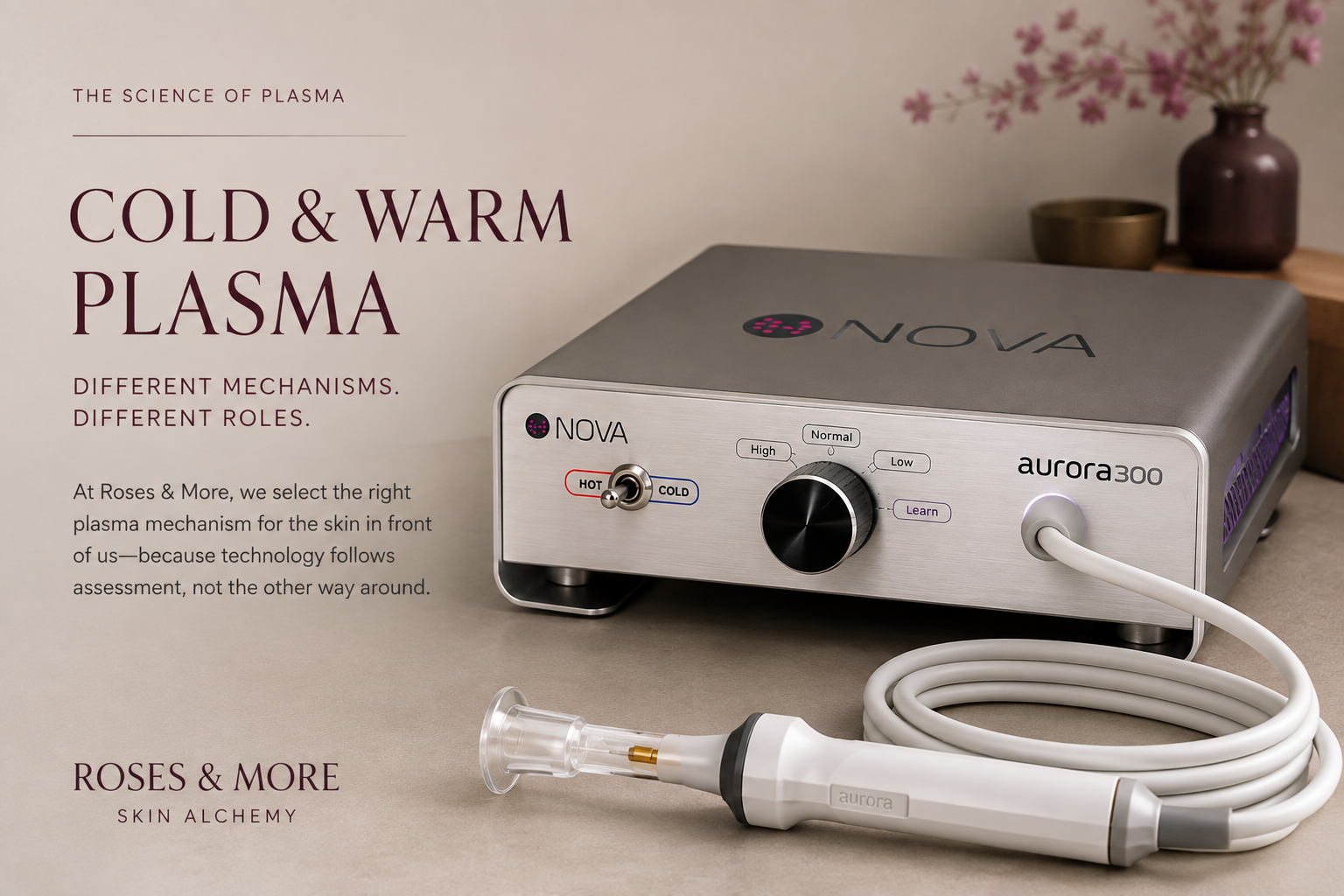
Plasma skin treatment Singapore clients encounter under one name can actually involve very different mechanisms. At Roses & More, NOVA Plasma provides both cold and warm/thermal plasma modes — but having both does not mean using both. Assessment determines whether plasma is appropriate, which mechanism fits the treatment objective, and how it should be sequenced.
What Is Plasma?
Plasma is often described as the fourth state of matter. In simple terms, it is an ionised gas containing charged particles. But in skin treatment, the word plasma can describe technologies that behave very differently.
That distinction matters. Cold atmospheric plasma and warm or thermal plasma do not provide the same kind of stimulus, and they should not be treated as interchangeable simply because they share the word “plasma”.
Plasma is not one treatment. Different plasma mechanisms can play very different roles.
Cold and Warm Plasma Are Not the Same Thing
At Roses & More, NOVA Plasma gives us access to both cold and warm or thermal plasma modes. Having both available expands the range of mechanisms we can consider. It does not mean that both automatically belong in every treatment.
The useful question is not simply, “What can plasma do?” It is: “What kind of stimulus does this particular skin need — and is plasma the appropriate way to provide it?”
| Characteristic | Cold Atmospheric Plasma | Warm / Thermal Plasma |
|---|---|---|
| Primary distinction | Non-thermal plasma | Thermal plasma |
| Principal stimulus | Plasma-generated reactive species and associated physical effects | Controlled thermal effect |
| Heat | Designed to operate without deliberate thermal heating of the skin | Heat is intentionally part of the treatment mechanism |
| Role at Roses & More | Considered where a non-thermal plasma mechanism fits the treatment objective | Considered where a controlled thermal mechanism fits the treatment objective |
| Automatically appropriate? | No. Selection follows assessment. | No. Selection follows assessment. |
Cold Atmospheric Plasma: A Non-Thermal Mechanism
Cold atmospheric plasma — often shortened to CAP — produces an ionised environment without relying on deliberate tissue heating as its principal mechanism.
Research into CAP examines the interaction of plasma-generated reactive oxygen and nitrogen species, charged particles, electric fields and other physical effects with biological tissue. This has led to growing scientific interest in areas including dermatology, wound research and skin biology.
That research is useful for understanding the mechanism. It does not mean that every laboratory or medical finding can automatically be translated into an outcome promise for a cosmetic plasma treatment.
Mechanism is not the same as a result. Understanding how a technology interacts with tissue helps us decide where it may belong. It does not allow us to predict an individual skin response.
Warm / Thermal Plasma: A Different Kind of Stimulus
Warm or thermal plasma deliberately introduces a controlled thermal effect. That puts it in a different treatment category from cold atmospheric plasma and gives it a different role within treatment planning.
Thermal plasma technologies have been investigated in aesthetic applications where controlled heating or resurfacing effects are desired. The extent and depth of those effects depend on the technology, settings, delivery method and treatment context.
This is why we avoid reducing warm plasma to phrases such as “more powerful” or “better”. A stronger or more thermal stimulus is not inherently more appropriate. It is simply a different mechanism.
What Does Continuous Plasma Mean?
The term continuous plasma describes the way plasma energy is delivered. It should not be confused with a claim that continuous delivery is automatically superior to every pulsed plasma technology.
With NOVA Plasma, the delivery architecture gives us another technical characteristic to consider alongside the distinction between cold and thermal modes. What ultimately matters to the client, however, is not the engineering label by itself. It is how that mechanism is selected and used within an appropriate treatment.
The sophistication is not owning more technology. It is knowing which mechanism belongs in the treatment — and when it does not.
Why Plasma Skin Treatment Singapore Should Begin With Assessment
Someone may arrive asking for plasma because they have heard about it for texture, ageing, breakouts, sensitivity or another concern. That request is useful information, but it does not make the treatment decision.
We first consider what the skin is actually presenting, the treatment objective, relevant history and tolerance, and whether a plasma mechanism makes sense at all.
If plasma is appropriate, the next question is which type of plasma stimulus belongs in the treatment. Cold and thermal modes may have different roles. They may be used separately. Their place in a wider treatment sequence may also change over time.
And sometimes plasma is not the answer. Another modality, a quieter restorative treatment, manual support, botanical care or simply restraint may make more sense.
Where NOVA Plasma Fits at Roses & More
NOVA Plasma is one part of a deliberately small technology portfolio at Roses & More. We value it because it gives us access to different plasma mechanisms rather than forcing every skin presentation into one mode of treatment.
But NOVA does not determine the protocol. The skin does.
That is the same principle that governs our wider technology approach: understand the presentation, establish the objective, choose the appropriate mechanism, and sequence treatment according to what the skin is ready for.
Our technology principle: We don’t choose the technology first. We choose what your skin needs.
The Scientific Takeaway
Plasma skin treatment is not one uniform category. Cold atmospheric plasma and warm or thermal plasma create fundamentally different treatment conditions.
Understanding those differences is more useful than asking which version is “best”. The better question is which mechanism — if any — is appropriate for the skin, objective and moment in front of us.
This article is intended for general educational information about plasma technology and Roses & More’s assessment-led approach. Research into plasma medicine and dermatology includes devices, settings and medical applications that are not necessarily equivalent to cosmetic treatment with NOVA Plasma. General research findings should not be interpreted as an individual treatment prediction or outcome guarantee.
Explore How We Choose Technology
Different mechanisms have different roles. See how Roses & More thinks about plasma, microneedling, spicules, ultrasound and manual support before deciding what belongs in a treatment.
Explore Our Technology WhatsApp Us64B Peck Seah Street, Tanjong Pagar, Singapore