
PDRN and exosomes Singapore skin treatments are increasingly discussed together, but they are not the same thing — and neither is automatically the right answer for every skin. Understanding what they are is useful. Deciding whether either belongs in a treatment comes afterwards.
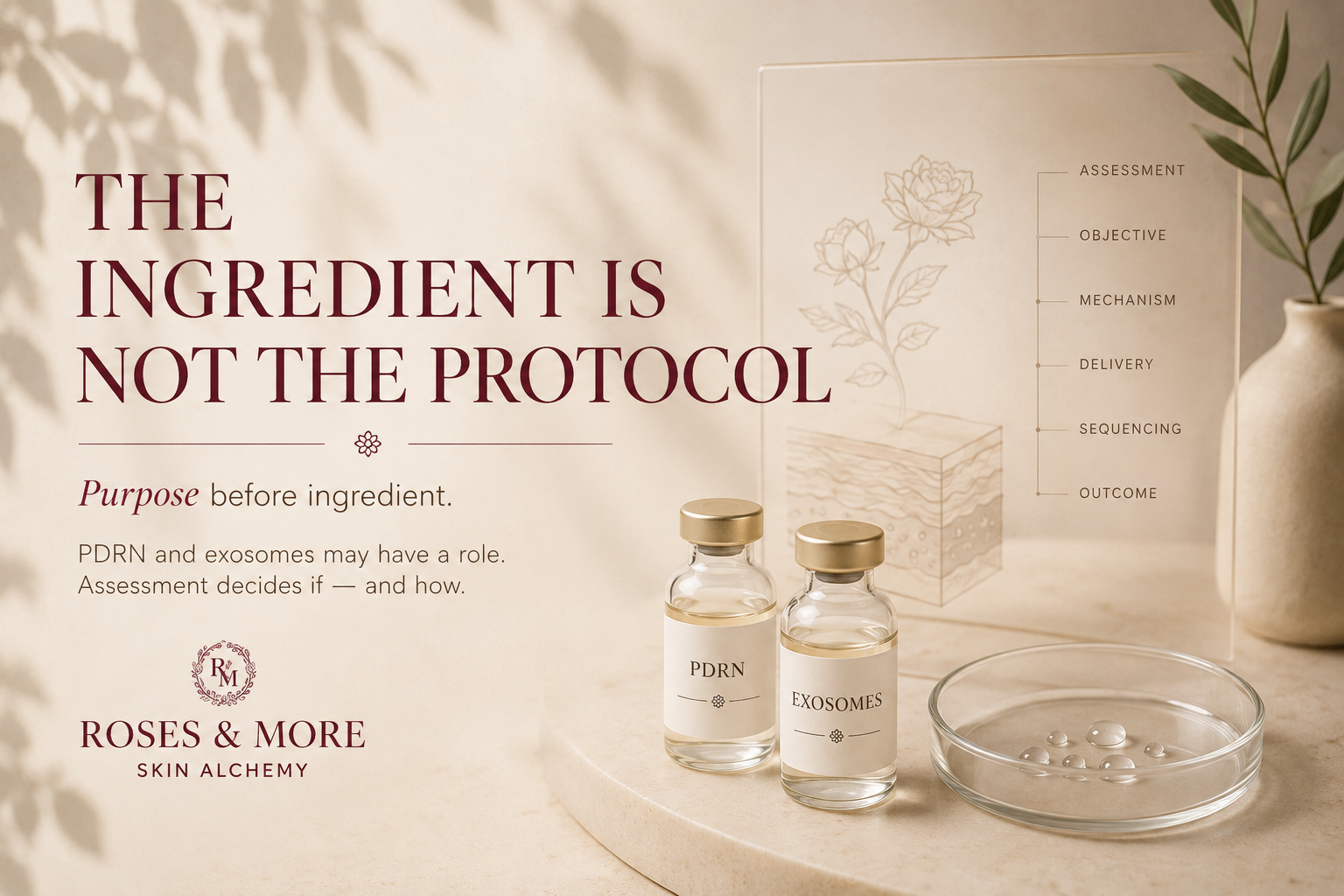
PDRN and Exosomes Are Not the Same Thing
PDRN and exosomes are often grouped together under broad terms such as regenerative skin care. That can make them sound like variations of the same ingredient. They are not.
PDRN — polydeoxyribonucleotide — refers to DNA-derived fragments that have been investigated in areas including tissue repair and wound healing. Exosomes are extracellular vesicles involved in cell-to-cell communication and can carry proteins, lipids and nucleic acids between cells.
Both are scientifically interesting. But scientific interest in a substance is not the same thing as proving that every cosmetic formulation, delivery method or treatment protocol containing it will produce the same effect.
An ingredient can have an interesting mechanism without becoming a universal treatment instruction.
Why the Delivery Method Matters
In professional skin care, the question is not simply whether a product contains PDRN or exosome-derived material. We also need to consider the formulation, its intended use, how it is being applied, the condition of the skin and what other treatment steps are involved.
Applying a topical product to intact skin is not equivalent to using it alongside a procedure that changes the skin surface. Nor should evidence from injectable or medical applications automatically be transferred to cosmetic topical use.
The ingredient name is only part of the story. Formulation, delivery, treatment context and the skin itself all affect whether a product has a sensible role.
Where PDRN or Exosome-Based Products May Enter a Treatment
At Roses & More, we do not begin an assessment by deciding that someone needs PDRN, exosomes or a combination of the two.
We begin with the objective and the skin in front of us. If an appropriate professional formulation has a useful role within that treatment, it may be considered as one component of the wider composition.
- What are we actually trying to achieve?
- What is the skin presenting today?
- Is the formulation appropriate for the intended use?
- How will it be applied or delivered?
- What other treatment mechanisms are being used?
- Is adding it useful — or merely adding complexity?
More Advanced Does Not Automatically Mean More Appropriate
Regenerative aesthetics is full of compelling language: growth factors, signalling, repair, renewal and cellular communication. Those concepts can be scientifically meaningful, but they can also become marketing shortcuts when they are detached from formulation, dose, delivery and evidence.
Roses & More would rather understand why something belongs in a treatment than use it because the ingredient is fashionable.
That applies equally to PDRN, exosome-based products, peptides, growth-factor formulations and other advanced actives. None receives an automatic place simply because it sounds sophisticated.
We don’t build the treatment around the fashionable ingredient. We decide whether the ingredient has a job in the treatment.
PDRN, Exosomes and Treatment Sequencing
Treatment sequencing gives us a more useful way to think about advanced actives. Instead of asking, “Should I get PDRN or exosomes?”, we can ask what the treatment is trying to accomplish and what combination of mechanisms and supportive steps makes sense.
Sometimes an advanced formulation may complement another treatment step. Sometimes a simpler formulation is sufficient. And sometimes introducing another active adds little except cost and complexity.
The sophistication lies in making that distinction.
The Useful Question Is Not Which One Is Better
PDRN versus exosomes makes an attractive comparison, but it is often the wrong starting question. Different materials have different biological properties, formulations differ, and the evidence surrounding their uses is still developing.
For the person receiving treatment, the more useful question is simpler: what does my skin need, and does this particular product have a defensible role in achieving it?
This article discusses cosmetic skin-care ingredients and treatment selection for general information. Research into PDRN, extracellular vesicles and exosome-based technologies spans medical, laboratory and cosmetic contexts that are not interchangeable. References to biological mechanisms should not be interpreted as medical treatment claims for a particular cosmetic product.
Build the Treatment Around the Skin
If you are curious about PDRN, exosomes or other advanced actives, we begin with what your skin is showing and what the treatment needs to accomplish — not with an ingredient trend.
Book via Fresha WhatsApp Us64B Peck Seah Street, Tanjong Pagar, Singapore